

Strategy
The Outward Direction: Rethinking Education in the Age of AI
The Line I Can’t Stop Thinking About
I heard Sir Ken Robinson once say, that:
Education is facilitating the learning to be able to think outside of oneself.
This line has earned its keep.
It’s not a definition of what education contains. It’s a definition of which direction education moves in.
That distinction turns out to be the whole argument.
A Direction, Not a Destination
Most definitions of education describe a destination – a body of knowledge, a set of skills, a credential. Robinson’s line describes a direction instead: outside of oneself. Away from the self as the organising centre of everything. That’s a strange thing to build a definition around, until you notice how rare it is. We measure education in facts retained, tests passed, skills acquired – all of it still centred on the individual doing the acquiring. Almost nobody defines it as a movement away from that individual.
But think about what actually changes a person, at any age, outside a classroom. It’s rarely more information about themselves. It’s understanding something that isn’t them – another person’s grief, an argument they didn’t want to be right, a history they didn’t live through, a discipline that doesn’t flatter their existing instincts. Growth, on this definition, isn’t accumulation. It’s displacement. You end up a little further from the centre of your own view than where you started.
That reframes the entire question of what we’re supposed to be doing with our minds now that AI exists. Not “how do we keep learning things.” “How do we keep moving outward” – and whether the tools we’ve built are actually pointed that way.
What the Latin Was Already Saying
Here’s what struck me once I sat with Robinson’s line next to the word’s own history. Education comes from two Latin roots that don’t fully agree: educare, to train or mold, and educere, to lead out – deriving from ex, “out,” plus ducere, “to lead.” Everyone who writes about educere stops at “out.” Meaning that one steps out of ignorance. Out of not-knowing, into knowing.
Nobody asks the more interesting question: out of what, exactly?
Robinson’s line answers it in a way the etymology never quite spells out on its own: out of the self. Not out of ignorance and into fact, but out of the private, self-referential frame each of us defaults to, and into the wider one – the world, other people, ideas that don’t originate with us. Read that way, educere and Robinson’s line are describing the same motion from two directions, two thousand years apart. That’s not something I’ve seen anyone connect explicitly, and once you see it, the rest of the argument falls into place almost on its own.
Educare, by contrast, doesn’t require that outward motion at all. You can be trained, drilled, shaped, optimised – entirely within the boundary of your existing self, your existing preferences, your existing patterns. Moulding doesn’t necessarily move you anywhere. It can just make you a more efficient version of where you already were.
The Self-Facing Machine
 Which is where AI becomes impossible to leave out of this conversation, because of what these systems are actually built to do. The dominant design goal of almost every AI system you interact with day to day – recommendation feeds, personalised assistants, generative tools that adapt to your style – is to model you more accurately. To predict what you already want, believe, or would say, and hand it back with less friction than it took the first time.
That is, structurally, the opposite motion to educere. It’s educare turned inward and automated: a machine training itself to reproduce your existing self back to you, faster and more convincingly each time. Not because anyone building it set out to trap you, because prediction is what the underlying technology is good at, and a system that reflects you accurately is, by every normal metric, a system that’s working.
The neural networks doing this prediction are explicitly modelled on the human brain; layers of weighted connections adjusting themselves in response to feedback, in imitation of how biological neurons strengthen and prune their own connections. We built a machine in the shape of our own capacity to adapt, and pointed a great deal of it inward, toward reflecting the very person it’s adapting to. That’s the part of the mirror that rarely gets named.
Window Versus Mirror
Here’s the image I keep coming back to, because it’s done more work for me than any longer explanation: education, on Robinson’s definition, is a window. It’s built to show you something that isn’t you. Most consumer AI, as currently designed, is a mirror. It’s built to show you a more polished, more responsive version of yourself.
Windows and mirrors can look identical from a few feet away – both are panes of glass you can address a question to. The difference only shows up in what comes back. A window shows you weather you didn’t choose, a street you don’t control, someone else’s life happening independently of your preferences. A mirror shows you… you, adjusted, flattered, occasionally sharpened, but never fundamentally elsewhere.
The danger isn’t that mirrors are bad. You need one sometimes, to check your own reasoning, to see your own writing more clearly, to catch what you missed in your own thinking. A mirror used deliberately, for a few minutes, is a tool. The danger is spending most of your waking hours in front of one while believing, the entire time, that you’re standing at a window because the glass looks identical and the machine never announces which one it’s being. Nobody warns you when a mirror is doing the work a window used to do. It just quietly starts, one convenient, well-phrased, agreeable answer at a time, and the shift is only visible in retrospect, if you’re looking for it at all.
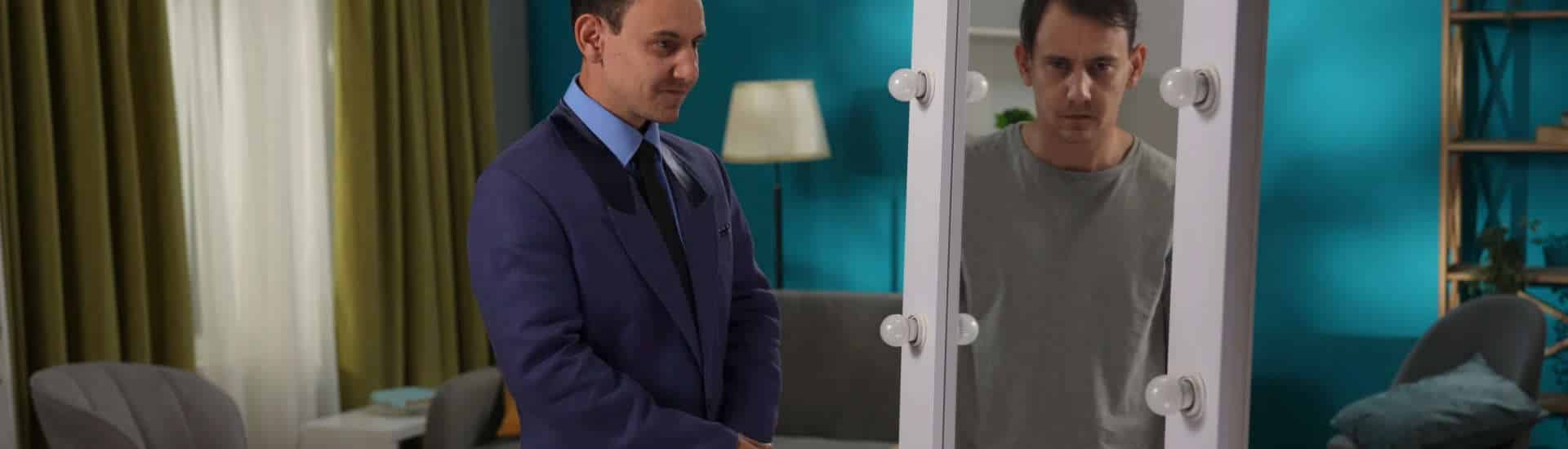
There’s also a subtler version of this worth naming: a mirror that’s good enough starts to feel like a window. A sufficiently sophisticated reflection of your own taste, your own politics, your own phrasing, can feel like discovery, because it arrives dressed as new information. That’s the most convincing version of the trap; not the obvious echo chamber, but the one polished enough that you mistake it for growth.
What the Research Actually Shows
This isn’t just a metaphor I like. There’s real evidence on both halves of it.
On the mirror side: researchers have spent over a decade studying what Eli Pariser named the Filter Bubble (https://www.penguinrandomhouse.com/books/309214/the-filter-bubble-by-eli-pariser/): the tendency of personalisation algorithms to build each user a slightly different, self-reinforcing information environment, showing more of what you already engaged with and less of what you didn’t. A controlled study by Cho and colleagues (https://escholarship.org/uc/item/9dr6q639), testing YouTube’s recommendation system with manipulated viewing histories, found the algorithm measurably reinforced participants’ existing political leanings rather than broadening them. Not every study agrees on how strong this effect is; the research field itself is honestly contested, and some large-scale audits have found weaker effects than the original thesis predicted. But the direction, where it appears, is consistently inward: toward confirming what’s already there, not outward toward what isn’t.
On the offloading side: a 2011 study led by psychologist Betsy Sparrow (https://www.science.org/doi/10.1126/science.1207745) found that heavy reliance on search engines changes what people bother to remember – people increasingly recall only where to find information, not the information itself. A 2025 study by Michael Gerlich (https://doi.org/10.3390/soc15010006) found a measurable negative relationship between frequent AI use and critical thinking performance, with the effect strongest in younger adults. Both findings describe the same quiet trade: the tool gets better at being you, and you get a little less practiced at being anyone else’s discovery, including the parts of yourself that only show up when you’re forced outward.
Robinson’s Own Words Back This Up
He said education should help people understand not just their own talents but “the world around them”, a phrase that only makes sense if the outward half is doing real work, not just decoration. He said its purpose was to produce people who are “active, compassionate citizens,” and compassion, definitionally, is the capacity to hold someone else’s experience as real without collapsing it back into your own. He distinguished learning, education, and school specifically to stop people flattening all three into one self-contained, self-referential idea of “getting smarter.”
All of those are restated, over and over, in the parts of his work that are on the record.
What Gets Lost When the Outward Motion Stops
If education is the outward motion, then what’s actually at risk in an AI-saturated life isn’t intelligence, and it isn’t even knowledge; both of those can rise while this atrophies. What’s at risk is the muscle that lets you take someone else’s reality seriously when it isn’t convenient, isn’t confirming, and isn’t about you.
That shows up in small ways before it shows up in large ones. Reaching for the version of an argument that agrees with you, because it’s a click away, instead of the version that would actually test it. Letting a tool phrase your disagreement with someone rather than sitting inside the discomfort of finding your own words for it. Mistaking a personalised feed’s sense of “everyone thinks this” for an accurate read of the world, when it’s actually an accurate read of you.
 None of this looks like ignorance from the outside. It can look like fluency, confidence, even sophistication. It’s a specific, quieter failure: a mind that’s gotten very good at being itself, and steadily worse at being led anywhere else.
It’s worth being precise about who this actually affects, because the honest answer is: everyone, including people who consider themselves well-read and open-minded. Sophistication isn’t a defence against this particular failure; if anything, it’s a better disguise for it. A well-informed person with a personalised information diet can construct an extremely articulate, well-cited version of a position they’d have held anyway, and mistake the articulation for having genuinely tested the idea. The outward motion isn’t measured by vocabulary. It’s measured by whether you can name, accurately and without straw-manning it, the strongest version of a view you don’t hold – and whether you’ve done that recently, on purpose, about something that actually matters to you.
Pointing the Machine Outward on Purpose
The mirror isn’t inevitable, it’s a default, and defaults can be overridden. The tool doesn’t decide which direction it faces. The question you bring to it does.
Used to confirm: tell me I’m right, finish my thought, say it the way I’d say it – AI operates as a mirror almost automatically, because that’s the shape of the request. Used to complicate: argue the other side, tell me what someone who disagrees with this would say, show me what I’m not accounting for – the same tool can function as something closer to a window, because you’ve deliberately aimed it at a reality that isn’t yours.
This takes more effort than the default, and it will always take more effort, because effort is exactly what a well-designed tool exists to remove. Pointing it outward is not something that happens by accident. It’s a decision you have to keep making, deliberately, against the grain of what the interface makes easiest.

The Discipline of Looking Out
So… how do we keep doing this, in a time of AI, at the level of an actual life and not a classroom? Not by rejecting the tools. Rather by refusing to let the ease of the mirror replace the harder, older work of the window.
That’s the discipline, stripped down: seek out what isn’t you, before you ask for more of what is. Read the argument you didn’t want to be right. Ask the tool to disagree with you before you ask it to agree. Let someone else’s experience sit there, unresolved into your own terms, for longer than feels comfortable.
I know what I heard Sir Ken Robinson say did to how I think about this, and that’s really the only proof a line like that needs to earn its place. Education, at its best, was never about filling yourself up. It was about learning to stand, on purpose, a little outside of where you started; and staying there long enough to actually see something.